Optimized Control Strategies for Cyber-Resilient Frequency Regulation in Multi-area Interconnected Power Systems
-
B22-125
-
Nov. 18, 2026 - Nov. 18, 2026
-
3 p.m. - 4 p.m.
Abstract
The increasing penetration of renewable energy resources and power-electronic-interfaced generation has introduced significant challenges to load frequency control (LFC) in modern microgrids due to reduced inertia, intermittent generation, dynamic load variations, parameter uncertainties, communication delays, and cyber-physical threats. This work investigates advanced and optimized control strategies for improving frequency stability in renewable-dominated microgrid systems. Different controller structures, including cascaded PIDD2–PI, fractional-order, disturbance-rejection, and predictive control schemes, are optimally tuned using recent metaheuristic optimization algorithms with performance indices such as ISE, ITSE, ITAE, and IAE. The proposed approaches are evaluated under step and random load perturbations, renewable-power fluctuations, high renewable penetration, parameter variations, communication delays, and false data injection (FDI) and denial-of-service (DoS) attacks. Comparative investigations against conventional PID, PI, PIDD2, fractional-order, and other benchmark controllers demonstrate significant reductions in frequency deviation, overshoot, undershoot, settling time, and accumulated error indices. For example, the optimized PIDD2–PI strategy achieves overshoot reductions of up to 89.23%, undershoot reductions of up to 78.22%, and settling-time improvements exceeding 56% compared with selected benchmark configurations, while advanced optimized controllers in RES-based microgrids achieve reductions exceeding 90% in several error and transient-performance indices. The robustness of the developed control frameworks is further demonstrated under ±40% parameter and inertia variations, renewable intermittency, communication constraints, and cyberattack conditions. Real-time implementation using the OPAL-RT OP4512 platform further validates the practical feasibility of selected cyber-resilient control strategies and confirms close agreement between offline simulation and real-time responses.
About the Speakers
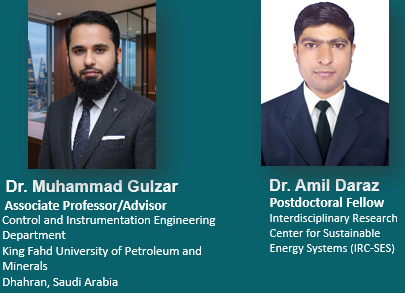
Dr. Muhammad Majid Gulzar (Senior Member, IEEE) is an Associate Professor in the Department of Control and Instrumentation Engineering (CIE), King Fahd University of Petroleum and Minerals (KFUPM), Saudi Arabia. He is a member of IEEE (Senior), IRC-SES, IRC-SML, PEC, and IEEEP (P). His areas of interest are Operation and Control of Renewable Energy Systems, Optimization Techniques and Applications, Control Systems, AGC/LFC in Smart Grids, AI/ML Techniques, etc. He has advised several projects in these areas and has published 175+ research papers with a commutative impact factor of 590+ in reputed international journals and conferences. Elsevier and Standard University, USA has placed him among the “Top 2% of scientists worldwide” for 2024 and 2025 in the field of Energy.
Dr. Amil Daraz is currently a Postdoctoral Fellow at the Interdisciplinary Research Center for Sustainable Energy Systems (IRC-SES), King Fahd University of Petroleum and Minerals (KFUPM), Saudi Arabia. He received his Ph.D. in Electronic Engineering, specializing in Power Control Systems, from the International Islamic University Islamabad. He previously served as a Postdoctoral Researcher at Zhejiang University, China. His research focuses on advanced power-system control, renewable-energy integration, hybrid and marine microgrids, load frequency control, intelligent optimization, fractional-order control, and cyber-resilient energy systems. He has authored/co-authored 58 scientific publications, including 45 impact-factor journal articles, and has received more than 1,570 Google Scholar citations with an h-index of 22. He is listed among the Stanford/Elsevier World’s Top 2% Scientists in the Energy field.