From Fault to Firewall Protecting the Inverter-Dominated Grids of Tomorrow
-
B22-125
-
Nov. 25, 2026 - Nov. 25, 2026
-
2 p.m. - 3 p.m.
Abstract
The power grid is changing at its core. As solar, wind, and storage replace the spinning machines that have powered grids for a century, they bring a hidden weakness. Inverter-based resources produce only a small fault current, about one to two times their rating, so the faults that traditional protection depends on detecting become hard to see. Islanded and hybrid AC/DC microgrids add interharmonic distortion, severe phase unbalance, and a new kind of threat in cyberattacks that can make healthy systems look faulty and faulty systems look healthy.
This talk follows a research journey that takes on these challenges one layer at a time. The first part rethinks protection for inverter-dominated microgrids. It covers active differential schemes that can detect elusive high-impedance faults, interharmonic signatures that reveal faults in hybrid AC/DC networks, and virtual-impedance fault limiters that coordinate protection without any communication link. It also covers an adaptive per-phase ride-through strategy that keeps unbalanced microgrids stable through the most severe asymmetrical faults. Every scheme has been proven in real-time hardware-in-the-loop testing on RTDS and OPAL-RT platforms.
The talk then moves from the microgrid to the wider grid through two internal IRC-SML projects at KFUPM. The first develops delay-aware ramp-rate control for utility-scale PV plants with battery storage, so that intermittent solar output meets strict grid codes. The second uses energy-storage-assisted control to make inverter- and EV-dominated hybrid microgrids resilient to severe faults.
Finally, a separate SDAIA-funded project brings the work into cybersecurity, using active cyber-physical authentication and distributed AI to separate real faults from false-data-injection attacks on line-current differential relays. The talk ends with a vision of tomorrow’s inverter-dominated grid that is secure, self-defending, and ready for a fully renewable future.
About the Speakers
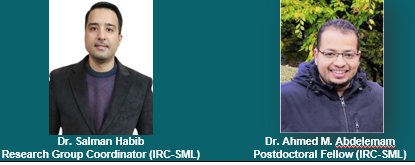
Dr. Ahmed M. Abdelemam (Member, IEEE) is a Postdoctoral Fellow at the Interdisciplinary Research Center for Smart Mobility and Logistics (IRC-SML) at King Fahd University of Petroleum and Minerals (KFUPM), Dhahran, Saudi Arabia, where he has worked since January 2026. He received his B.Sc. (Honors) and M.Sc. in Electrical Power Engineering from Helwan University in 2010 and 2016. In 2024 he received his Ph.D. in Electrical Engineering and Computer Science from the Advanced Power and Energy Center at Khalifa University, Abu Dhabi, UAE. His research covers protection, fault ride-through, and cyber-physical security of inverter-dominated and hybrid AC/DC microgrids. He also works on renewable integration and energy-storage-supported control. His work appears in leading journals including IEEE Transactions on Industrial Informatics, IEEE Transactions on Smart Grid, Applied Energy, Protection and Control of Modern Power Systems, and the Journal of Energy Storage, and several of these papers rank in the top 1–2% of their fields. Dr. Abdelemam is a voting member of the IEEE 762 standard and the P762 working group. The group sets definitions for reporting the reliability, availability, and productivity of electric generating and storage units. He reviews for several IEEE journals, including IEEE Transactions on Power Delivery, IEEE Transactions on Smart Grid, IEEE Transactions on Power Systems, and IEEE Transactions on Industry Applications.
Dr. Salman Habib is an Assistant Professor in the Department of Control and Instrumentation Engineering at King Fahd University of Petroleum and Minerals (KFUPM). He has 15 years of academic, industrial, and research experience in power system operation and control, intelligent microgrid operation and energy management, grid-integrated technologies, controlled Charging solutions for electric vehicles, and artificial intelligence applications in energy systems. Dr. Habib has published over 115 research papers with a commutative impact factor of 547+ in leading journals and conferences. He has been recognized among the world’s top 2% of scientists for the years 2024, 2025 and 2026. He is presently leading and contributing several projects at KFUPM, focusing on the electrification of transportation systems and the operation and planning of power systems, serving as PI and Co-I, which reflects his leadership and collaborative capabilities.