Edge-enabled Resilient False Data Injection Attack Detection in Cyber-Physical Power Distribution Networks
-
B22-125
-
Nov. 18, 2026 - Nov. 18, 2026
-
2 p.m. - 3 p.m.
Abstract
] Advanced Metering Infrastructure (AMI) consists of communication networks facilitating information exchange between control centers and user-end devices through private or third-party networks. Because of their cyber-physical features and large-scale connectivity, AMIs are highly vulnerable to cyberattacks from both inside and outside. Among these attacks, false data injection (FDI) attacks are important because they directly disrupt the decision-making processes in AMI. Numerous detection strategies have been developed to mitigate these cyber-risks; nonetheless, difficulties regarding robustness persist. This work proposes an edge-based detection framework that integrates random Fourier features (RFF) for effective data transformation with an optimized extreme gradient boosting (XGBoost) classifier. Compared to other works in literature, the proposed approach reduced communication delays and network congestion. Additionally, the developed framework mitigates the FDI attacks in real-time with an improved FDI detection rate and isolation of affected nodes. The proposed topology is developed to accurately detect multiple types of FDI attacks in AMI environments. Extensive experimental evaluations under six distinct FDI scenarios have been taken to demonstrate superior performance in terms of detection accuracy, AUC, MAP, and reduced false alarm rates compared to existing benchmark and state-of-the-art methods.
About the Speakers
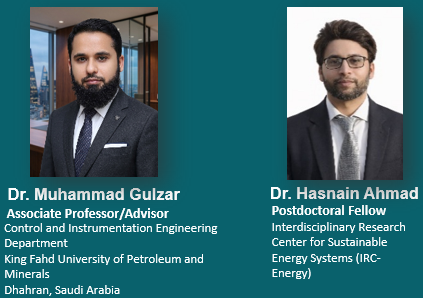
Dr. Muhammad Majid Gulzar (Senior Member, IEEE) is an Associate Professor in the Department of Control and Instrumentation Engineering (CIE), King Fahd University of Petroleum and Minerals (KFUPM), Saudi Arabia. He is a member of IEEE (Senior), IRC-SES, IRC-SML, PEC, and IEEEP (P). His areas of interest are Operation and Control of Renewable Energy Systems, Optimization Techniques and Applications, Control Systems, AGC/LFC in Smart Grids, AI/ML Techniques, etc. He has advised several projects in these areas and has published 175+ research papers with a commutative impact factor of 590+ in reputed international journals and conferences. Elsevier and Standard University, USA has placed him among the “Top 2% of scientists worldwide” for 2024 and 2025 in the field of Energy.
Dr. Hasnain Ahmad (Senior Member, IEEE) received the M.Sc. degree in Power and Control Engineering from the University of Central Punjab, Lahore, Pakistan, in 2019, and the Ph.D. in Electrical Engineering from the Pakistan Institute of Engineering and Applied Sciences (PIEAS), Islamabad, Pakistan, in 2025. He is currently a Postdoctoral Researcher with the Interdisciplinary Research Center for Sustainable Energy Systems (IRC-SES), King Fahd University of Petroleum and Minerals (KFUPM), Saudi Arabia. Previously, he held academic, industrial, and government research positions, including Senior Design Engineer at the National Institute of Electronics, Ministry of Science and Technology, Pakistan, and Lecturer in the electrical engineering and computer science departments at PIEAS and Qarshi University. Dr. Ahmad has authored/coauthored more than 34 journal articles, conference papers, and book chapters published in reputable international venues. His publications have received more than 545 citations, and he has an h-index of 13. He received a competitive overseas research award under the International Research Support Initiative Program of the Higher Education Commission of Pakistan and conducted part of his Ph.D. research in the Department of C&IE, KFUPM. His research interests include industrial cybersecurity, cyber-physical power systems, artificial intelligence, anomaly and intrusion detection, smart grids, renewable energy integration, distributed control, digital twins, and intelligent energy management.