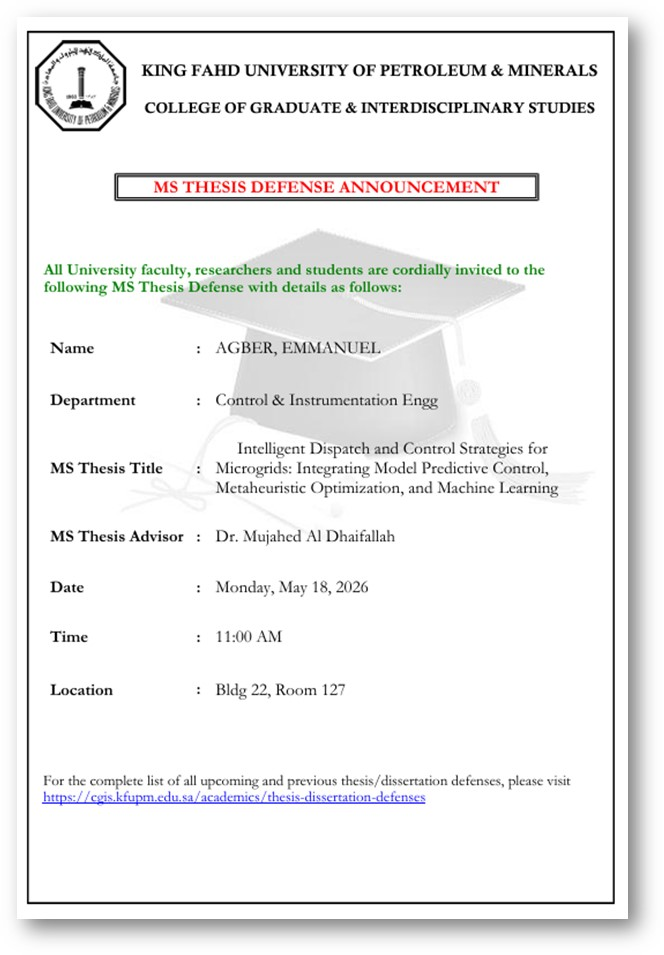
MS Thesis Defense on "Intelligent Dispatch and Control Strategies for Microgrids: Integrating Model Predictive Control, Metaheuristic Optimization, and Machine Learning"
-
22-127
-
May 18, 2026 - May 18, 2026
-
11 a.m. - noon
Abstract
This thesis develops an intelligent dispatch framework using an off-grid PV–diesel generator–battery hybrid renewable energy system (HRES) in Dammam, Saudi Arabia as case study. Conventional HOMER Pro dispatch strategies such as Load Following, Cycle Charging, and Combined Dispatch are rule-based and do not fully capture future load variation, PV intermittency, battery state-of-charge behavior, or lifecycle cost. To address this limitation, the study proposes a SEMPA–MPC–ML framework that combines SEMPA-based sizing optimization, MPC-generated optimal dispatch trajectories, machine-learning surrogate modeling, and HOMER Pro custom dispatch implementation.
Unlike direct MPC or metaheuristic-based dispatch methods that require repeated online optimization during operation, the proposed approach performs the computationally intensive optimization offline. The optimized MPC trajectories are then converted into lightweight regression-based battery and generator set-point equations. This allows the dispatch intelligence of MPC to be retained while avoiding the heavy computational burden of solving MPC, GA, PSO, MPA, or SEMPA at every simulation time step.
The framework is evaluated over an annual 8,760-hour horizon using total net present cost, LCOE, renewable fraction, unmet load, generator operation, battery behavior, and converter limits. The selected HOMER ML-MPC base case achieves an NPC of $125,421, LCOE of $0.172/kWh, renewable fraction of 60.9%, and unmet load of 0.00165%. Overall, the thesis demonstrates that MPC-derived dispatch behavior can be transferred into simple machine-learning rules, enabling practical, fast, and long-horizon techno-economic evaluation of advanced HRES dispatch in HOMER Pro.
Speaker Bio:
Mr. AGBER, Shima Emmanuel is currently pursuing a Master of Science in Systems & Control Engineering at King Fahd University of Petroleum & Minerals (KFUPM). He earned his Bachelor of Engineering in Electrical and Electronics Engineering from University of Agriculture Makurdi, Nigeria. His research interests include sustainable energy, system identification, Machine learning, and optimal control.