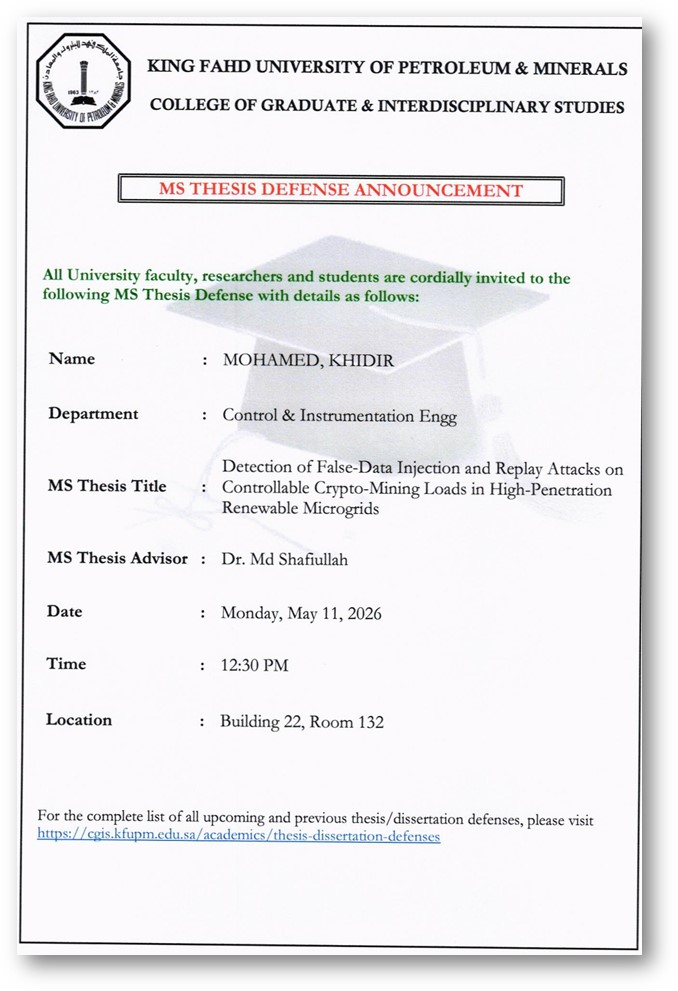
MS Thesis Defense on "Detection of False-Data Injection and Replay Attacks on Controllable Crypto-Mining Loads in High-Penetration Renewable Microgrids"
-
22-132
-
May 11, 2026 - May 11, 2026
-
12:30 p.m. - 1:30 p.m.
Abstract:
This thesis proposes a cyber-secure measurement-channel framework for load frequency control in an islanded microgrid with cryptocurrency mining load as a flexible demand resource. The framework is based on recursive keyed watermarking and is strengthened by introducing quantization to reduce sender-receiver mismatch and K-of-M confirmation logic to improve detection robustness. It combines watermark embedding and reconstruction, receiver-side signal recovery, unknown input observer-based residual generation, and residual-based detection of false data injection, replay, and time-delay attacks. The thesis also develops an online diagnosis framework that uses rolling-window features extracted from recovered measurements, observer residuals, watermark-consistency indicators, and temporal descriptors, followed by hierarchical bagged-tree classification to identify attack presence, attacked channel, and attack family. The results show fast and reliable detection, with reported detection latencies between 0.127 and 0.161 s, and strong diagnosis performance, with a mean accuracy of 0.9703 and a mean macro-$F_1$ score of 0.9500. Real-time implementation on a dSPACE SCALEXIO platform further confirms the practical feasibility of the proposed approach.
Speaker Bio:
Khidir Mohamed is a Research Assistant and M.Sc. holder in Systems and Control Engineering at King Fahd University of Petroleum and Minerals (KFUPM), Dhahran, Saudi Arabia. He received his B.Sc. degree in Electrical and Electronic Engineering (Control) from the University of Khartoum, Sudan. His research interests include intelligent control, optimization, and automation for power and energy systems. He has authored and presented peer-reviewed IEEE and journal papers on metaheuristic-based load frequency control and microgrid dynamics. He has industrial and teaching experience in PLCs, SCADA, and VSDs.