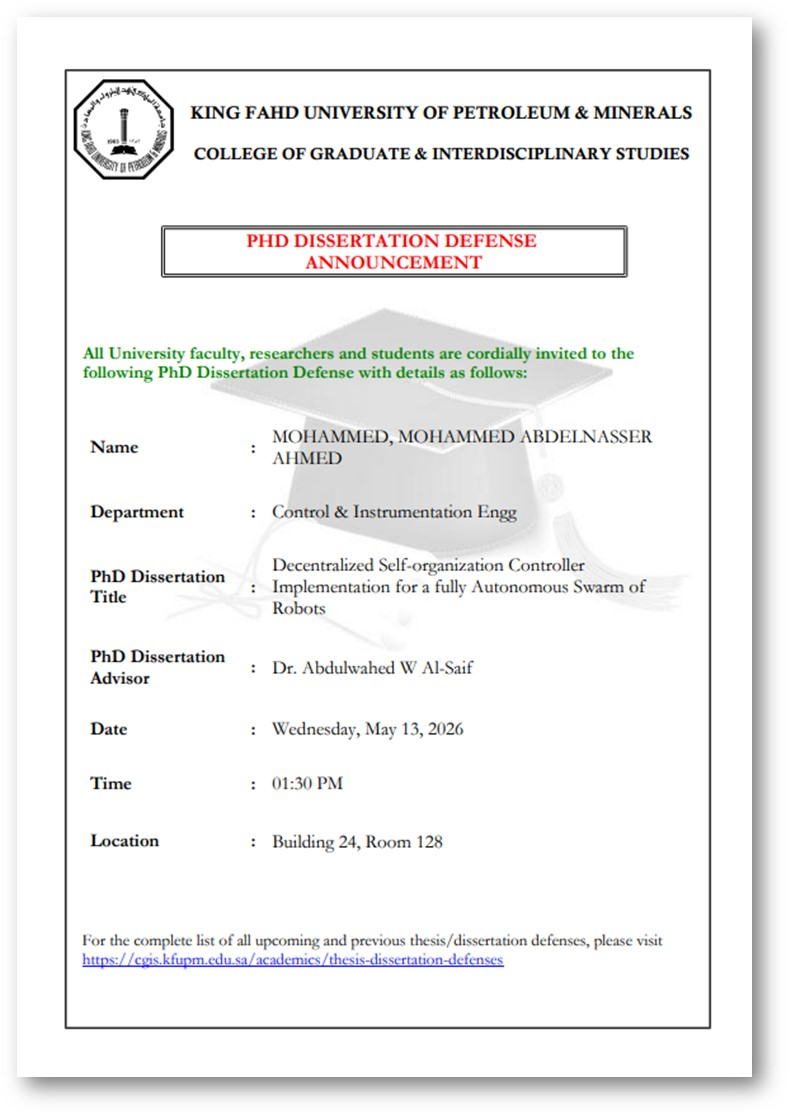
PhD Dissertation on "Decentralized Self-Organization Controller Implementation for a Fully Autonomous Swarm of Robots"
-
24-128
-
May 13, 2026 - May 13, 2026
-
1:30 p.m. - 2:30 p.m.
Abstract:
In this work, we propose a fully decentralized, self-organizing control framework for a swarm of autonomous ground mobile robots. The system integrates potential field-based mechanisms for simultaneous trajectory tracking, formation control, and obstacle avoidance, all based on local sensing and neighbor interactions without centralized coordination. Each robot autonomously computes attractive, repulsive, and formation forces to navigate toward target positions while maintaining inter-robot spacing and avoiding both static and dynamic obstacles. Inspired by biological swarm behavior, the controller emphasizes robustness, scalability, and flexibility.
To further enhance the performance of the proposed framework, task-level hyperparameter optimization is investigated to improve convergence efficiency while preserving collective behavior and fully decentralized operation. In this way, the control architecture maintains its decentralized nature without requiring centralized information exchange and respecting communication data capacity constraints.
The proposed method has been successfully validated in the ARGoS simulator, which provides realistic physics, sensor modeling, and a robust environment that closely approximates real-world conditions. The system was tested with up to 15 robots and is designed to scale to larger swarms (e.g., 100 robots), demonstrating stable performance across a range of scenarios.
Results obtained using ARGoS confirm the swarm’s ability to maintain formation, avoid collisions, and reach a predefined goal area within a configurable 1 m radius. This zone serves as a spatial convergence region suitable for multi-robot formation, even in the presence of unknown fixed obstacles and movable agents. The framework can seamlessly handle the addition or removal of swarm members without reconfiguration.
Speaker Bio:
Mohammed Abdel-Nasser received the B.Sc. and M.Sc. degrees from the Mechatronics Engineering Department, Assiut University, Egypt, in 2016 and 2021, respectively. He is currently pursuing the Ph.D. degree in systems and control and engineering with the Control and Instrumentation Engineering Department, King Fahd University of Petroleum and Minerals. His main research interests include robotics, machine learning applications, and optimization. His area of specialization includes swarm robotics control.